

Automate It with a Flow
Wire your connectors and transformation into a single flow, run its tasks in parallel where possible, give it a schedule, and get notified when it fails.
You have four configurations that each do one thing when you click Run. A flow turns them into one pipeline that runs in the right order, at the right time, without you. Step 5 of the Getting Started arc.
What you need
Section titled “What you need”Everything from the previous steps, in one project:
- the
[TUTORIAL] Sample dataHTTP configuration from Load Your Data, - the
Denormalize opportunitiestransformation from Transform Your Data, - the Google Sheets destination from Send Your Data Somewhere.
Phases and tasks
Section titled “Phases and tasks”A flow is a list of phases. Each phase holds one or more tasks — a component configuration to run, a notification to send, a variable to set.
- Tasks inside one phase run in parallel.
- Phases run one after another, and the flow only moves on when a phase is finished.
That is the whole model, and it makes the ordering obvious: things that can happen at the same time go in one phase; things that depend on each other go in separate phases. Your pipeline is three phases — extract, transform, deliver — because the transformation needs the four tables before it can join them, and the sheet needs the joined table before it can deliver it.
Each phase here holds a single task, so nothing runs in parallel yet. Parallelism shows up the moment you have a second source: two connectors both go in phase 1 and run at the same time. Inside your HTTP configuration the four tables are already fetched by one job — row-based components like this one can be parallelized internally.
Flows can also branch on what happened: retry a task, take a different path on failure, end early. That is conditions, and you need none of it yet.
Build the flow
Section titled “Build the flow”-
Open Flows in the navigation — the section itself is titled Conditional Flows — and click Create Flow. Name it
[TUTORIAL] Opportunity pipeline, add a description, and click Create Flow again in the dialog.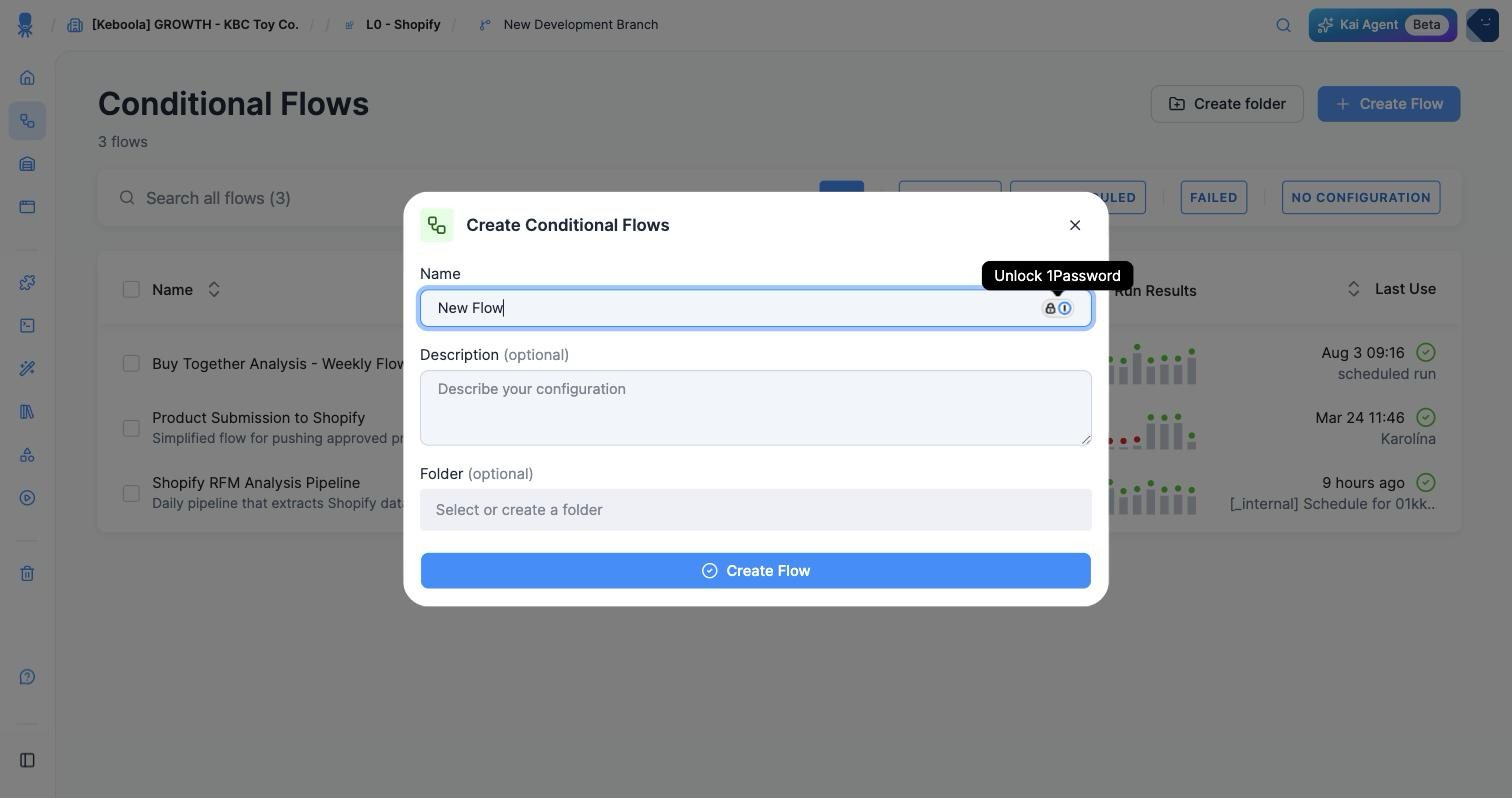
-
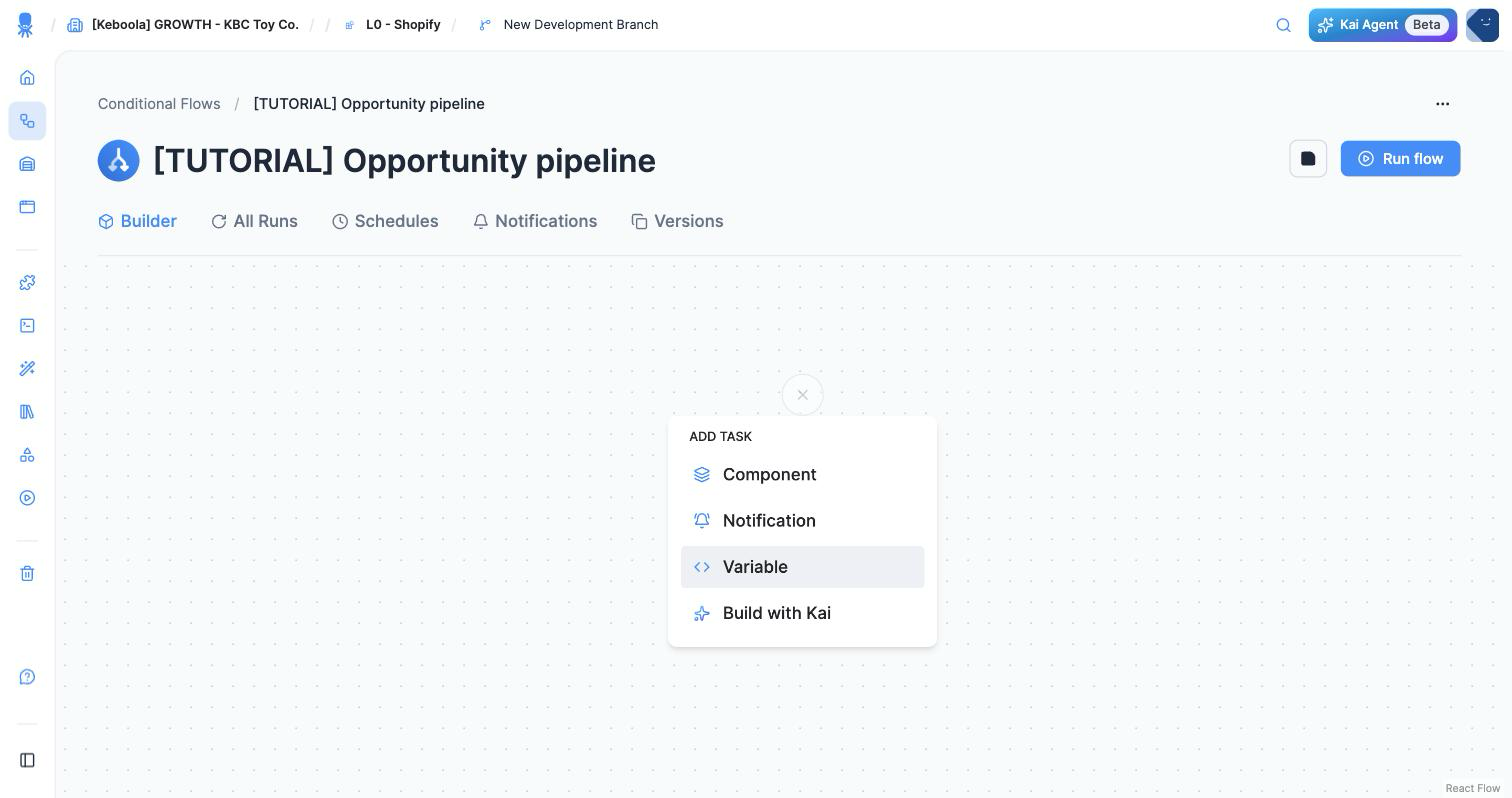
You land in the Builder on an empty canvas, with an Add Task menu already open: Component, Notification, Variable and Build with Kai. Choose Component.
-
Select Component opens. It lists what the project has, with a configuration count each — pick HTTP, then the
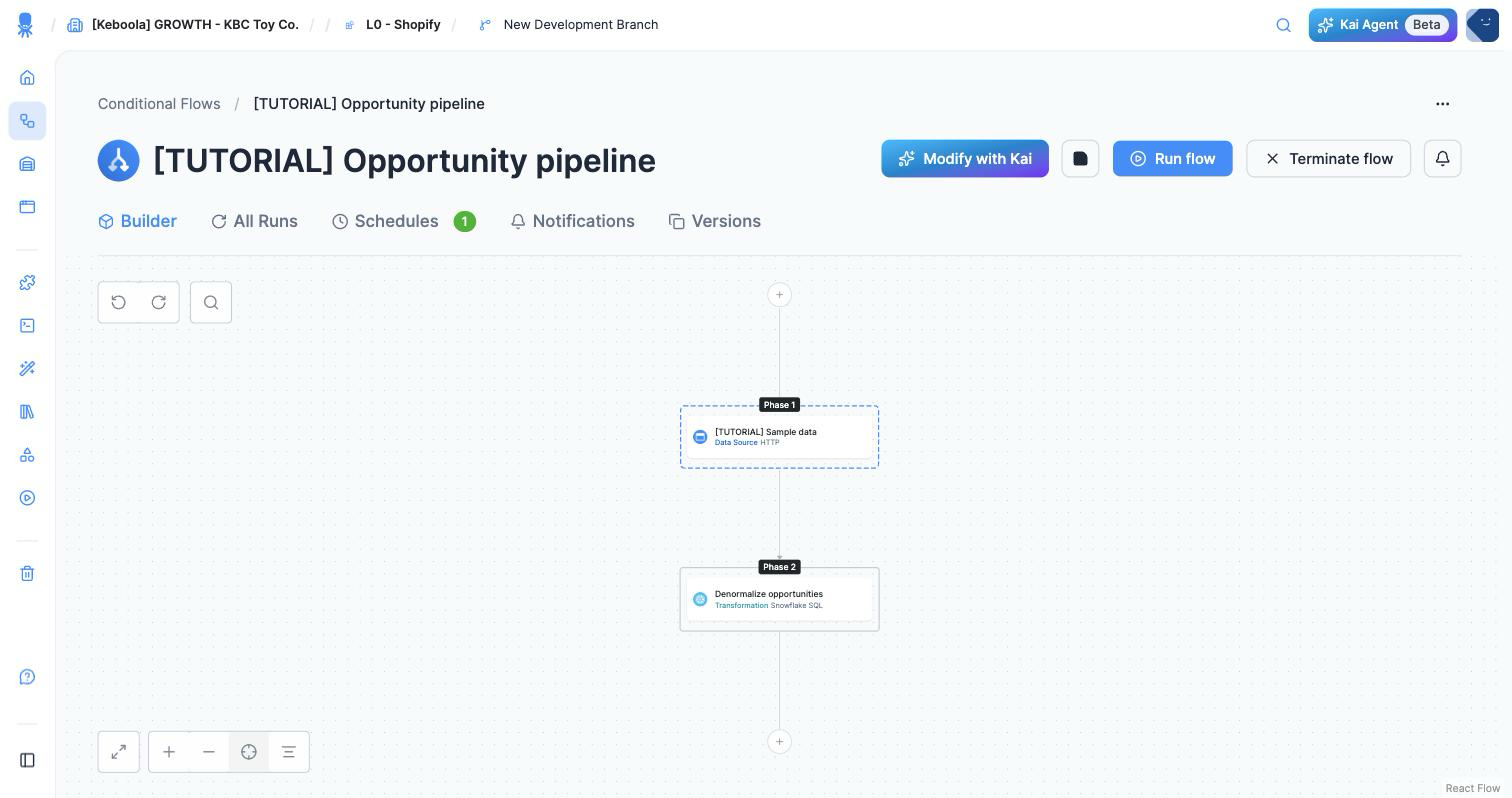
[TUTORIAL] Sample dataconfiguration. It drops onto the canvas as a task inside a box labelled Phase 1.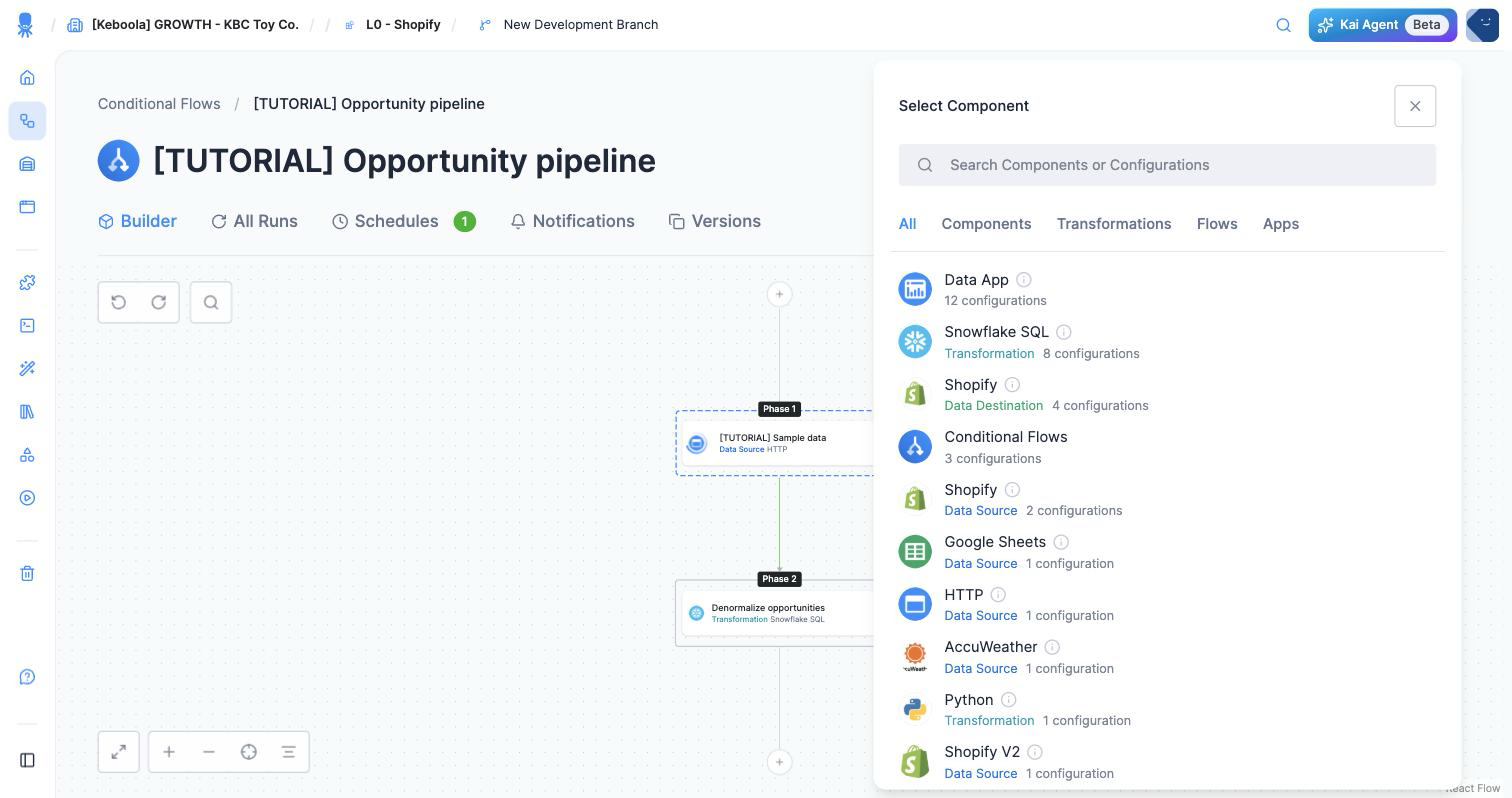
-
Click the + below Phase 1. That is the control that starts a new phase — the plus between phases adds a phase, not a task to the one above it. Add the
Denormalize opportunitiestransformation there. Being in a later phase is what guarantees the tables have landed before the SQL runs.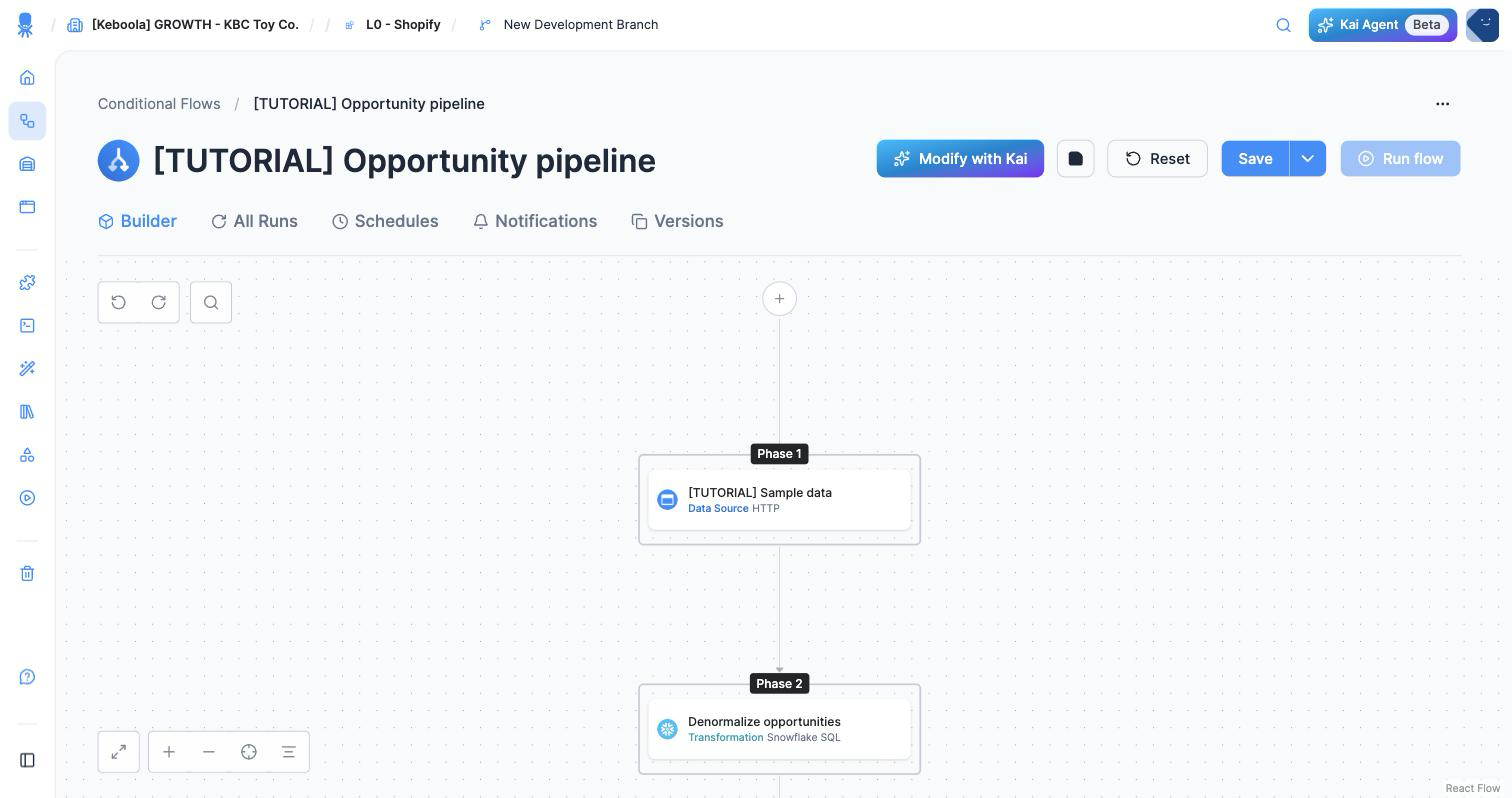
-
Repeat for a third phase holding the Google Sheets destination configuration.
-
Click Save. The Builder keeps your changes as a draft until you do — Reset throws them away, and Run flow stays disabled until the flow is saved.
You now have three phases: the load, then the transformation, then the delivery.
Run it
Section titled “Run it”Click Run flow and confirm with Run. A Conditional Flows job has been scheduled notification appears with a Show job link, and while the run is in progress the header offers Terminate flow.
Every task creates its own job, so Jobs tells you exactly which step failed if one does, and the flow’s own All Runs tab shows each run with its phases.
Set a schedule
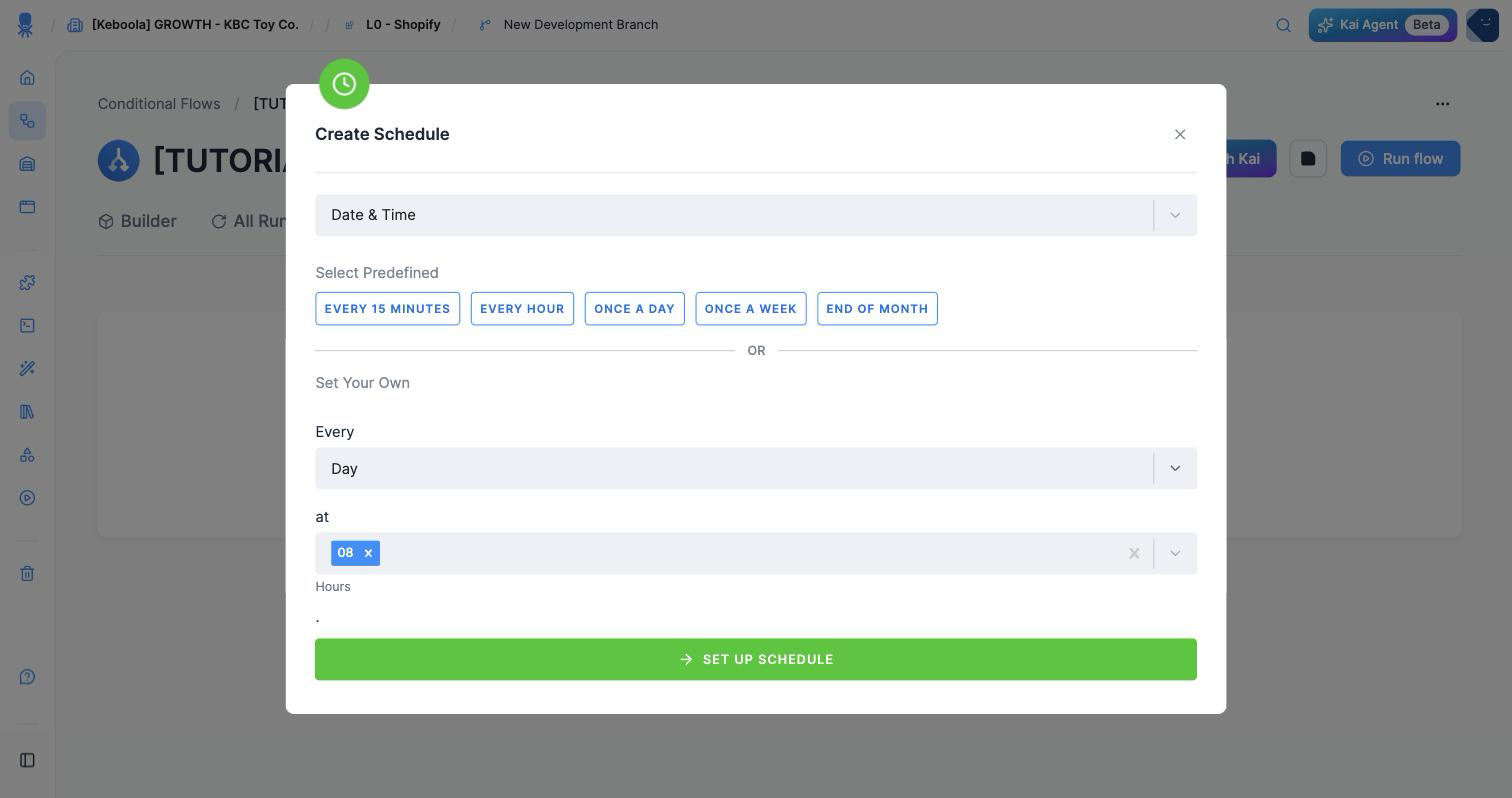
Section titled “Set a schedule”Open the flow’s Schedules tab and click Create Schedule. Pick a predefined interval — Every 15 minutes, Every hour, Once a day, Once a week, End of month — or set your own under Set Your Own (every day/week/month, at an hour and minute you choose). Then click Set Up Schedule.
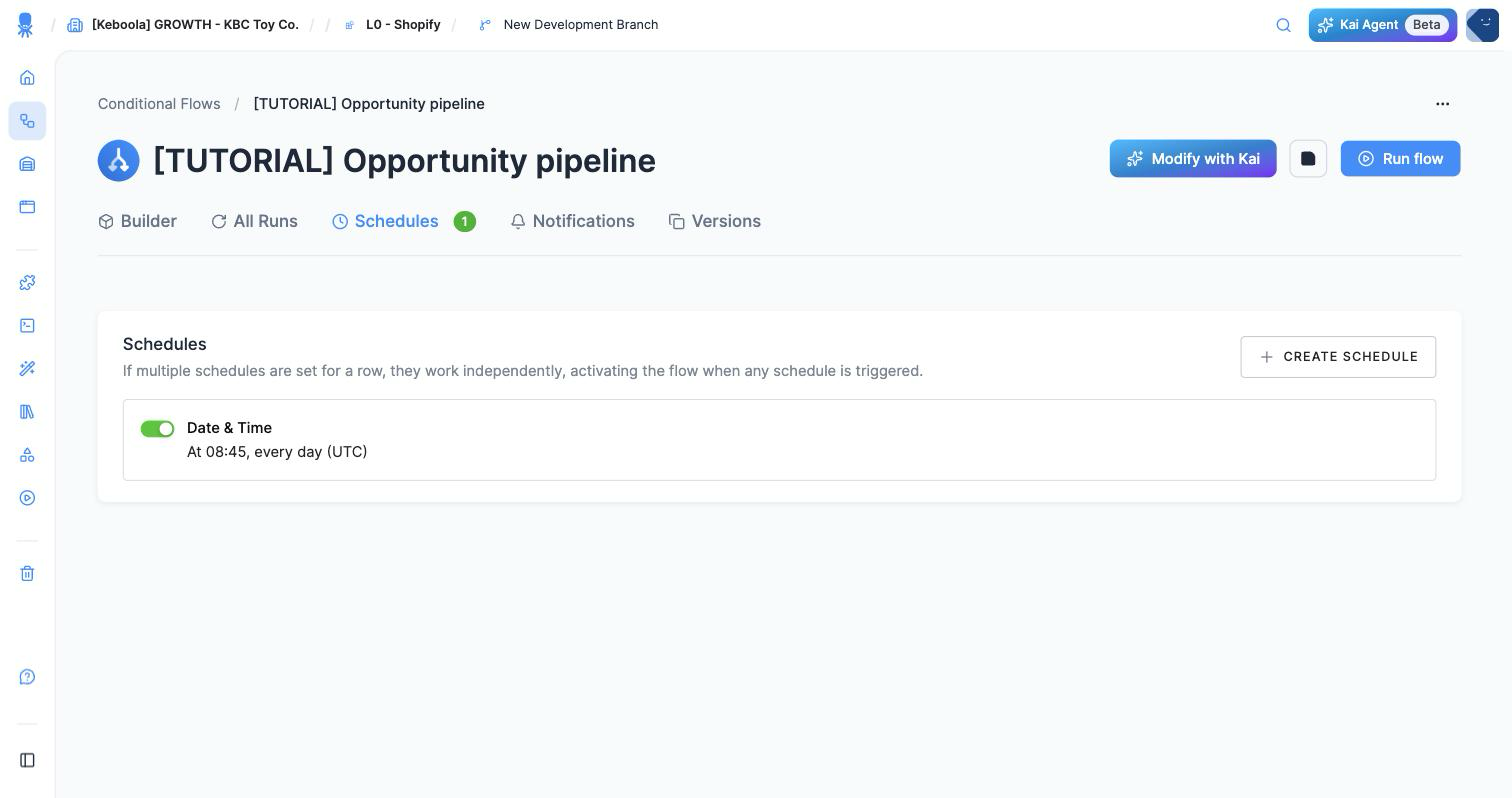
The schedule appears in the tab with a toggle, so you can pause it without deleting it, and the tab shows a count. A flow can hold several schedules: they work independently, and the flow runs whenever any of them fires. Times are UTC.
If you share a stack with other projects, scheduling slightly off the hour avoids the busiest moments. A schedule can also be driven by a table changing rather than a clock — see Schedule and Automate.
Get told when it breaks
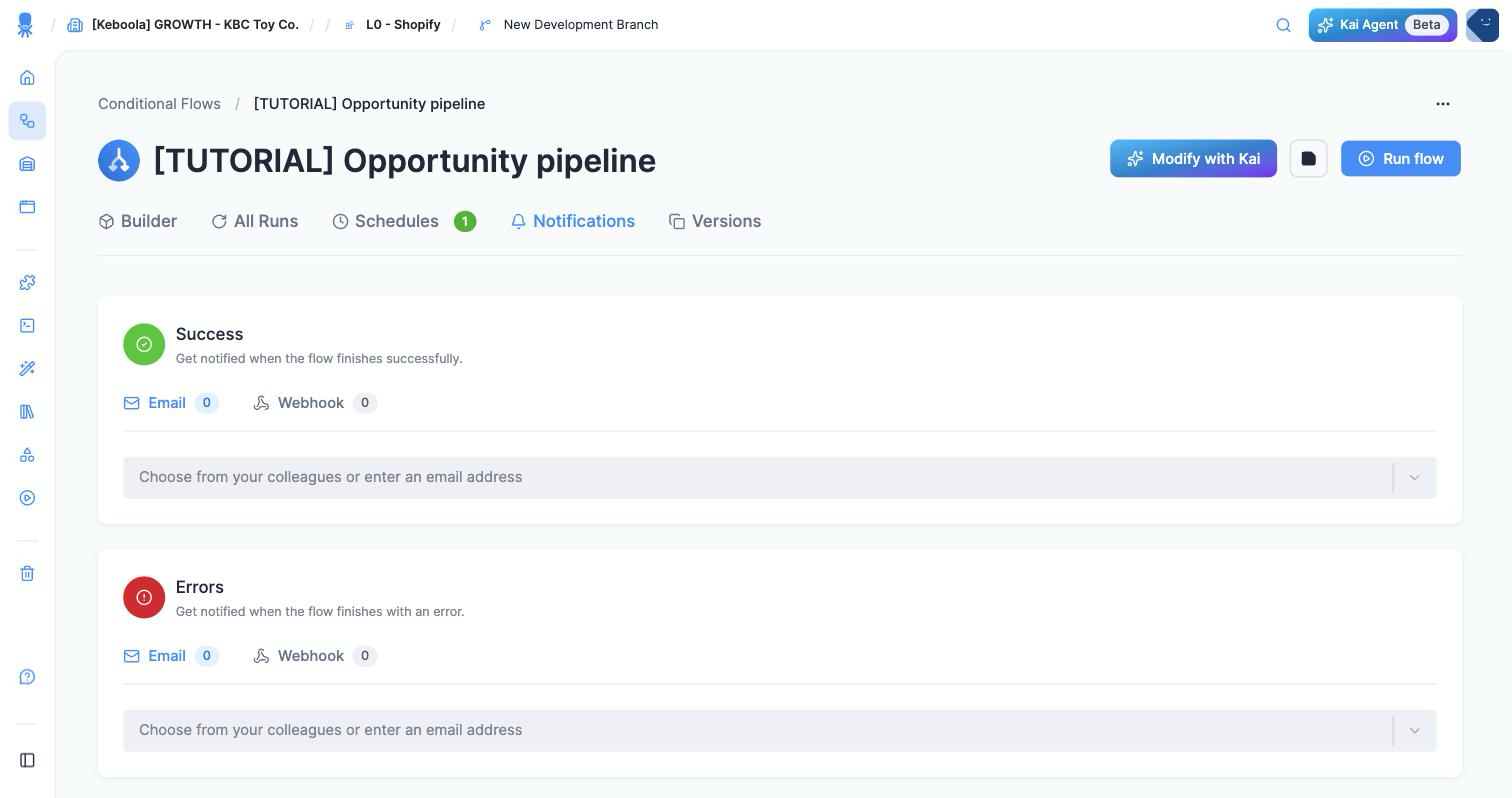
Section titled “Get told when it breaks”An automated pipeline that fails silently is worse than a manual one. Open the flow’s Notifications tab — there is nothing to click into, you edit it in place. Three cards:
| Card | Fires when |
|---|---|
| Success | the flow finishes successfully |
| Errors | the flow finishes with an error |
| Processing | the job runs longer than usual, by a percentage you set |
Each takes Email addresses (pick colleagues or type any address) or a Webhook URL. Fill in Errors at minimum — on a scheduled production flow that is the one setting nobody should skip.
There is a second, finer mechanism: a Notification task placed inside the flow, driven by a condition such as if any task in the flow ended with an error. That is what you reach for when one flow needs different alerts for different failures; these three cards are enough here.
Check it worked
Section titled “Check it worked”The flow’s All Runs tab is the place to look: a duration chart over time, then a table of runs with who or what started them — your name for a manual run, scheduled run for the schedule — plus duration and status. Expand a run to see its phases.
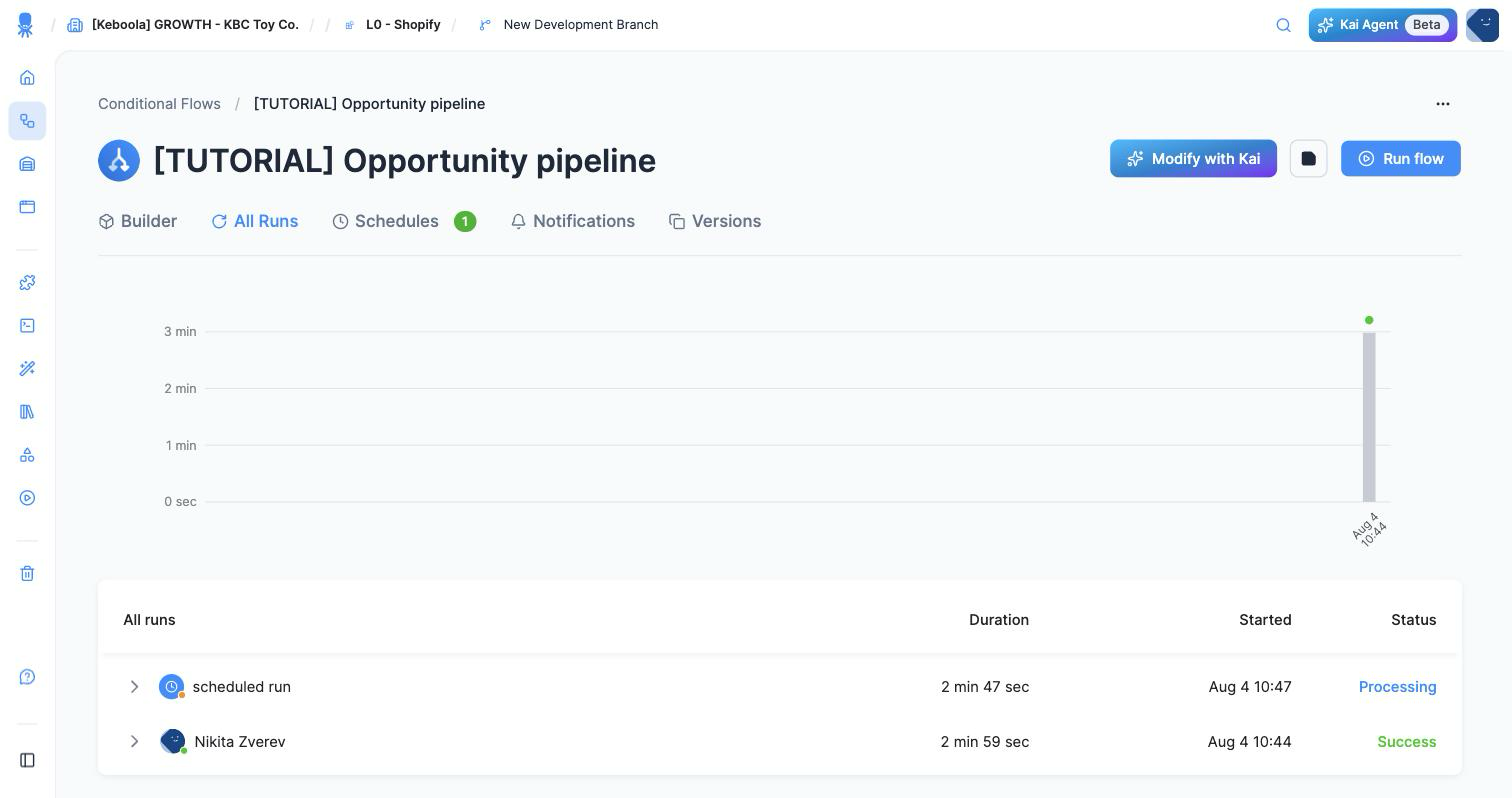
- One run with status Success. End to end this pipeline takes around three minutes, most of it the four HTTP fetches.
- Jobs lists more entries than you might expect: a job per task, a Conditional Flows phase job per phase, and the Conditional Flows job for the run itself. That is normal.
- The Schedules tab shows a count, and the schedule can be toggled off without deleting it.
If it goes wrong
Section titled “If it goes wrong”- The transformation fails inside the flow but works on its own. Its phase is running before the load finishes — check that the connector sits in an earlier phase, not the same one.
- Everything succeeds but the sheet is unchanged. The destination ran before the transformation wrote its output, or its phase is missing entirely. Read the run detail top to bottom.
- The scheduled run never happens. The schedule was saved but the flow is disabled, or the project is out of runtime credits — Free Plan projects get up to 60 minutes a month, and while flow jobs themselves consume none, the component jobs they start do.
- Jobs queue instead of running. Too many parallel tasks in one phase; Storage jobs are typically capped at 10 in parallel. Split the phase.
Next: Where to go next →